Installation
We highly recommend that you create a compartmentalized software environment, inside of which
you can install rrlfe and all the right versions of packages that it relies on.
To create such an environment with conda, follow the instructions here.
(Use Python version 3.8 at the step ''To create an environment with a specific version of Python.'')
Activate the environment:
conda activate rrlfe_env
Pip install rrlfe:
pip install rrlfe
Make a directory (say, rrlfe_io/) to contain the I/O of your reduction. cd to it, and grab some files directly from the repo which we
will need:
wget https://raw.githubusercontent.com/mwanakijiji/rrlfe/main/src.tar.gz
tar -xvf src.tar.gz
Pip install the packages listed in the requirements file:
pip install -r requirements.txt
In the parent directory which contains rrlfe_io/, clone the Python port of Robospect and install it
by following the instructions here.
Then make directory robospect.py/tmp/ and copy the file ll to it from the rrlfe_io/ directory. (This
file tells Robospect where to look for absorption lines in the spectra.)
That’s it! You’re ready to roll. To try a test run in the rrlfe_io/ directory, run the sample script which was contained in the tar file:
python example_calibration_application_min_working_example.py
(Be sure to edit the pathname at the top of the script appropriately.)
If you would ever like to file an issue on the rrlfe Github repo, you can do so here.
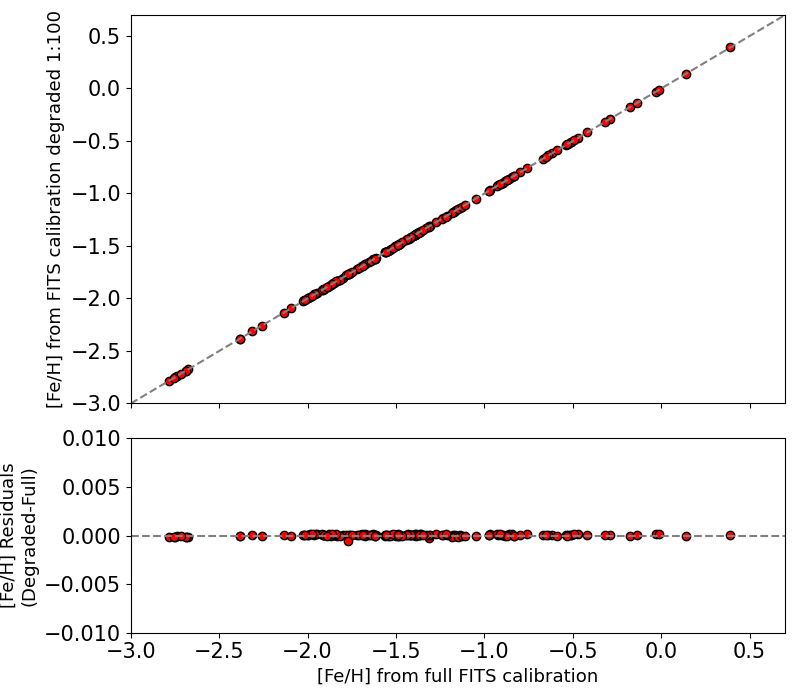
Note: The repository code contains a 3 Mb FITS file deg_1-100_calib_solution_20230507.fits, which contains the calibration solution corresponding to that in the paper Spalding et al. 2023 MNRAS 527:828, except that it is a 1:100 undersampling of the posterior chain links. Using the ‘degraded’ version provided, however, produces [Fe/H] retrievals which differ negligibly from those using the full, 300 Mb calibration file. (The full calibration file is available on request.)
Below is a plot showing how the answers differ between the full and 1:100 degraded calibration. The variation is negligible compared to typical [Fe/H] uncertainties of ~0.15.